Membranous Epithelial Tissues
1. Introduction
Epithelial tissue is one of the four basic types of tissues in the body. It covers body surfaces, lines internal cavities, and forms glands. It acts as a protective barrier and performs functions such as absorption, secretion, and sensation.
2. Meaning and Characteristics of Epithelial Tissue
Epithelial tissue is made up of closely packed cells with very little space between them. The cells are arranged in continuous sheets and are held tightly together by junctions.
It rests on a basement membrane which separates it from the underlying connective tissue.
Epithelial tissues have no blood vessels (they are avascular) and receive nutrients by diffusion from surrounding tissues.
Main characteristics:
Cells are closely packed with little or no space.
Have a free surface exposed to the body’s exterior or internal cavity.
Rest on a basement membrane.
Avascular but supplied by nerves.
Capable of regeneration.
3. Functions of Epithelial Tissue
Protection: covers and shields underlying tissues.
Absorption: takes up substances like nutrients in the intestines.
Secretion: forms glands that release enzymes, hormones, or mucus.
Excretion: helps remove waste products.
Sensation: contains sensory nerve endings.
4. Classification of Epithelial Tissues
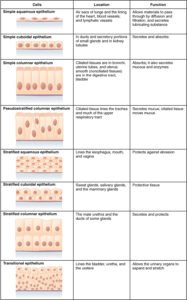
Epithelial tissues are classified based on the number of cell layers and the shape of the cells.
A. Based on Number of Layers
Simple epithelium: single layer of cells.
Stratified epithelium: multiple layers of cells.
Pseudostratified epithelium: appears to have several layers but all cells touch the basement membrane.
B. Based on Cell Shape
Squamous: flat and thin cells.
Cuboidal: cube-shaped cells.
Columnar: tall, rectangular cells.
Transitional: variable shape, found in organs that stretch like the bladder.
5. Types of Membranous Epithelia and Their Locations
6. Simple squamous epithelium – single layer of flat cells.
Location: lining of blood vessels, air sacs of lungs (alveoli).
Function: diffusion and filtration.
7. Simple cuboidal epithelium – single layer of cube-like cells.
Location: kidney tubules, glands.
Function: secretion and absorption.
8. Simple columnar epithelium – tall cells with nuclei near the base.
Location: lining of the stomach and intestines.
Function: absorption and secretion.
9. Pseudostratified columnar epithelium – appears layered but all cells touch the basement membrane.
Location: lining of the trachea and respiratory tract.
Function: secretion and movement of mucus by cilia.
10. Stratified squamous epithelium – several layers of flat cells.
Location: skin, mouth, and esophagus.
Function: protection from friction and wear.
11. Transitional epithelium – multiple layers that change shape when stretched.
Location: urinary bladder.
Function: allows stretching and relaxation.
12. Specialized Modifications of Epithelial Cells
Cilia: hair-like projections that help move substances (found in respiratory tract).
Microvilli: tiny projections that increase surface area for absorption (found in intestines).
Goblet cells: secrete mucus to lubricate and protect surfaces.
Keratinization: tough protein layer on surface cells for protection (found in skin).
7. Basement Membrane
The basement membrane is a thin layer that separates epithelial tissue from underlying connective tissue.
Functions:
Supports and anchors the epithelium.
Controls exchange of materials between epithelium and connective tissue.
Provides surface for cell attachment and regeneration.
8. Regeneration and Repair
Epithelial tissues can regenerate rapidly because of their high rate of cell division. This allows them to heal quickly after injury.
9. Clinical Relevance
Damage to epithelial tissues can lead to ulcers, burns, or cancers.
In CAM, understanding epithelial tissue helps in managing skin conditions and improving healing through herbal and nutritional therapy.
10. Summary
Epithelial tissue covers body surfaces and lines internal cavities.
It is classified based on cell layers and shape.
It performs vital functions such as protection, absorption, and secretion.
Specialized structures like cilia and microvilli enhance its functions.
In CAM, epithelial health reflects the effectiveness of natural therapies in maintaining or restoring body balance.
Video Credits
The educational videos in this course are credited to the following creators:
All videos are embedded directly from YouTube for educational purposes and remain the property of their respective creators.