Module 9: Specialized Connective Tissues III – Blood
1. Introduction
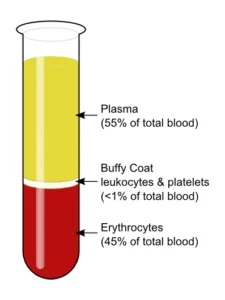
Blood is a specialized type of connective tissue that plays a vital role in the transportation of substances, defense against infection, and maintenance of homeostasis. Although it looks like a fluid, blood fits the definition of connective tissue because it consists of cells suspended in an extracellular matrix called plasma.
2. Composition of Blood
Blood is composed of two main components:
Plasma: The liquid part of blood that makes up about 55% of its volume.
Formed elements: The solid portion, consisting of blood cells (red blood cells, white blood cells, and platelets).
3. Plasma
Plasma is a pale-yellow fluid made up of about 90% water, with dissolved substances such as proteins, nutrients, hormones, electrolytes, and waste products.
Main plasma proteins include:
Albumin: Maintains osmotic pressure and transports substances.
Globulins: Include antibodies that help fight infections.
Fibrinogen: Important for blood clotting.
Functions of plasma:
Transports nutrients, gases, hormones, and waste products.
Helps regulate body temperature.
Maintains acid-base balance and blood pressure.
4. Formed Elements of Blood
A. Red Blood Cells (Erythrocytes)
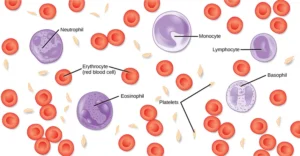
Biconcave, disc-shaped cells that lack nuclei.
Contain hemoglobin, the pigment that binds and carries oxygen.
Main function: Transport oxygen from the lungs to body tissues and carry carbon dioxide back to the lungs for removal.
Produced in the red bone marrow through a process called erythropoiesis.
Average lifespan: about 120 days.
B. White Blood Cells (Leukocytes)
Have nuclei and function mainly in defense against infections and foreign substances.
Classified into two major groups:
1. Granulocytes: Contain granules in their cytoplasm.
Neutrophils: Most numerous; destroy bacteria by phagocytosis.
Eosinophils: Involved in allergic reactions and defense against parasites.
Basophils: Release histamine during inflammatory reactions.
2. Agranulocytes: Lack visible granules.
Lymphocytes: Include B cells (produce antibodies) and T cells (regulate immune response).
Monocytes: Transform into macrophages that engulf dead cells and pathogens.
C. Platelets (Thrombocytes)
Small, irregularly shaped cell fragments.
Function in blood clotting and prevention of excessive bleeding.
Produced in the bone marrow from large cells called megakaryocytes.
5. Functions of Blood
Transports oxygen, carbon dioxide, nutrients, hormones, and waste products.
Regulates body temperature, pH, and fluid balance.
Protects the body through white blood cells and antibodies.
Prevents blood loss through clotting mechanisms.
6. Hematopoiesis
Hematopoiesis is the process of blood cell formation, which occurs primarily in the red bone marrow. All blood cells develop from stem cells that differentiate into various specialized cells.
7. Differences Between Plasma and Serum
Plasma: The liquid part of blood containing clotting factors like fibrinogen.
Serum: Plasma without clotting factors; obtained after blood has clotted.
8. Clinical Relevance
Anemia: A condition where red blood cells or hemoglobin levels are low, leading to reduced oxygen transport.
Leukemia: Cancer of white blood cells causing abnormal proliferation.
Thrombocytopenia: Low platelet count resulting in poor clotting and easy bleeding.
Infections and inflammations can be detected through changes in white blood cell counts.
In Complementary and Alternative Medicine, improving blood health involves nutrition rich in iron, folate, and vitamin B12, along with natural detoxification and circulation-enhancing herbs.
9. Summary
Blood is a fluid connective tissue made up of plasma and formed elements.
Red blood cells transport oxygen, white blood cells defend the body, and platelets help in clotting.
It plays vital roles in transport, protection, and regulation.
Maintaining healthy blood is essential for life, and CAM emphasizes natural dietary and herbal approaches to support blood purification, oxygenation, and immune strength.
Video Credits
The educational videos in this course are credited to the following creators:
All videos are embedded directly from YouTube for educational purposes and remain the property of their respective creators.