Lymphoid Tissue
1. Introduction
Lymphoid tissue is a specialized type of connective tissue that plays a central role in the body’s immune defense system. It helps protect the body against infections and diseases by producing, storing, and activating lymphocytes (white blood cells). Lymphoid tissue forms the main structural component of lymphoid organs such as lymph nodes, spleen, thymus, tonsils, and Peyer’s patches in the intestine.
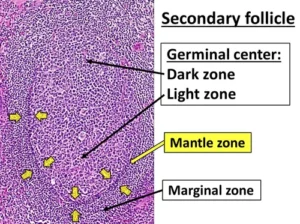
2. Characteristics of Lymphoid Tissue
Lymphoid tissue is made up of a network of reticular fibers that support numerous lymphocytes and other immune cells. It is richly supplied with blood and lymphatic vessels. Unlike other tissues, its main function is not structural support but immune defense.
3. Functions of Lymphoid Tissue
- Produces lymphocytes (B cells and T cells).
- Filters lymph to remove foreign particles, bacteria, and dead cells.
- Initiates immune responses against pathogens.
- Stores immune cells and antibodies.
- Helps maintain body fluid balance through lymph circulation.
4. Types of Lymphoid Tissues
A. Primary (Central) Lymphoid Organs
These are the sites where lymphocytes are produced and mature before they become active in defense.
Bone marrow: The site of origin of all blood cells. It produces B lymphocytes and releases immature T cells.
Thymus gland: The site where immature T lymphocytes mature and become functional. It is most active during childhood and shrinks with age.
B. Secondary (Peripheral) Lymphoid Organs
These are the sites where lymphocytes become activated to respond to foreign invaders.
Lymph nodes: Small, bean-shaped structures that filter lymph and trap microorganisms.
Spleen: Filters blood, removes old red blood cells, and activates lymphocytes.
Tonsils: Protect the upper respiratory tract from infection.
Peyer’s patches: Found in the wall of the small intestine and help defend against intestinal pathogens.
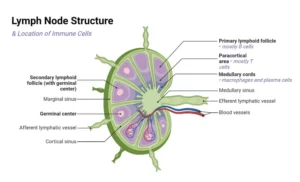
5. Structure and Function of Major Lymphoid Organs
A. Lymph Nodes
Small, oval organs located along lymphatic vessels.
Contain lymphocytes and macrophages that filter and destroy harmful particles in lymph.
They swell during infection due to increased immune activity.
B. Spleen
The largest lymphoid organ in the body.
Has two main parts:
White pulp: rich in lymphocytes, responsible for immune functions.
Red pulp: removes worn-out red blood cells and stores platelets.
Functions: filters blood, recycles iron, and participates in immune defense.
C. Thymus
Located in the upper chest behind the sternum.
Essential for T-cell development and immune regulation.
Most active during early life and gradually decreases in size after puberty.
D. Tonsils
Located in the throat region (pharynx).
Act as the first line of defense against inhaled or ingested pathogens.
E. Peyer’s Patches
Clusters of lymphoid follicles found in the wall of the small intestine.
Monitor intestinal bacteria and prevent the growth of harmful microbes.
6. Types of Lymphocytes and Their Roles
B lymphocytes (B cells): Produce antibodies that neutralize pathogens.
T lymphocytes (T cells): Destroy infected or abnormal cells and regulate immune responses.
Natural killer (NK) cells: Destroy virus-infected and cancerous cells without prior sensitization.
7. Circulation of Lymph
Lymph is a clear fluid that circulates through lymphatic vessels. It collects tissue fluid, passes through lymph nodes for filtration, and returns to the bloodstream. This circulation helps remove waste and transport immune cells throughout the body.
8. Clinical Relevance
Lymphadenopathy: Enlargement of lymph nodes due to infection or cancer.
Lymphoma: Cancer of lymphoid tissue affecting lymphocytes.
Splenomegaly: Enlargement of the spleen caused by infection or blood disorders.
In Complementary and Alternative Medicine, supporting lymphatic health involves detoxification therapies, massage, hydration, herbal lymph tonics (like red clover and cleavers), and nutrition that enhances immunity.
9. Summary
Lymphoid tissue forms the backbone of the immune system.
It consists of primary organs (bone marrow and thymus) and secondary organs (lymph nodes, spleen, tonsils, and Peyer’s patches).
Its main role is to produce and activate lymphocytes that defend the body against infection.
Healthy lymphoid tissue ensures strong immunity, and in CAM, maintaining lymphatic balance is essential for detoxification and disease prevention.
Video Credits
The educational videos in this course are credited to the following creators:
All videos are embedded directly from YouTube for educational purposes and remain the property of their respective creators.