Muscular Tissues
1. Introduction
Muscular tissue is a specialized type of tissue responsible for producing movement in the body. It is composed of elongated cells called muscle fibers that have the ability to contract and relax. Muscle tissue not only enables movement but also maintains posture, stabilizes joints, and generates heat.
2. Characteristics of Muscular Tissue
Muscle cells are elongated and arranged in parallel bundles. They contain contractile proteins, actin and myosin, which slide over each other during contraction. Muscles are richly supplied with blood and nerves. They have high energy requirements and contain many mitochondria.
3. Functions of Muscular Tissue
– Produces movement of body parts.
– Maintains posture and body position.
– Supports internal organs.
– Produces heat during contraction to maintain body temperature.
– Controls the size of openings in organs such as blood vessels and intestines.
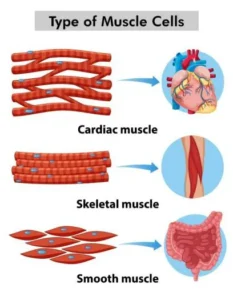
4. Types of Muscular Tissues
There are three main types of muscular tissues based on structure and control mechanism.
A. Skeletal Muscle (Striated Voluntary Muscle)
– Made up of long, cylindrical, multinucleated fibers with visible striations.
– Attached to bones by tendons.
– Contraction is under voluntary control (conscious effort).
– Function: responsible for movement of the skeleton, posture, and facial expressions.
– Location: muscles of the arms, legs, face, and trunk.
B. Cardiac Muscle (Striated Involuntary Muscle)
– Found only in the walls of the heart.
– Cells are branched, have one nucleus, and are joined by intercalated discs, which allow coordination and rhythm in contraction.
– Contraction is involuntary and rhythmic.
Function: pumps blood continuously throughout the body.
C. Smooth Muscle (Non-Striated Involuntary Muscle)
– Composed of spindle-shaped cells with one nucleus and no visible striations.
– Found in walls of internal organs such as the stomach, intestines, blood vessels, and uterus.
– Contraction is involuntary and slower but more sustained.
– Function: moves substances through hollow organs and regulates internal flow such as peristalsis in intestines and vasoconstriction in arteries.
5. Comparison of the Three Types of Muscle
Skeletal muscle is striated, voluntary, and multinucleated, located in body muscles, and contracts rapidly.
Cardiac muscle is striated, involuntary, has a single central nucleus, is located in the heart, and contracts rhythmically.
Smooth muscle is non-striated, involuntary, has a single nucleus, is found in internal organs, and contracts slowly but steadily.
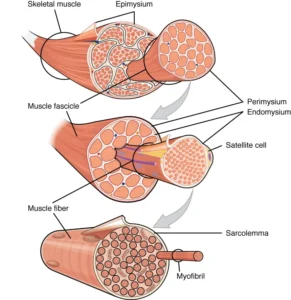
6. Structure of a Skeletal Muscle Fiber
The sarcolemma is the cell membrane of the muscle fiber.
The sarcoplasm is the cytoplasm containing mitochondria and glycogen.
Myofibrils are thread-like structures that contain actin and myosin filaments responsible for contraction.
A sarcomere is the functional unit of contraction within the myofibril.
7. Neuromuscular Junction
A neuromuscular junction is the point where a motor nerve connects with a muscle fiber. When a nerve impulse reaches the junction, it releases a chemical messenger called acetylcholine, which triggers muscle contraction.
8. Energy Source for Muscle Contraction
Muscle contraction requires adenosine triphosphate (ATP), which provides the energy for the sliding of actin and myosin filaments. The mitochondria in muscle cells produce ATP through respiration.
9. Clinical Relevance
Muscle fatigue occurs when muscles run out of energy due to lack of oxygen or buildup of lactic acid.
Muscle atrophy is the wasting away of muscle due to disuse or disease.
Muscle hypertrophy is the increase in muscle size from regular exercise.
Cramps and spasms are sudden involuntary contractions caused by dehydration or electrolyte imbalance.
In Complementary and Alternative Medicine, maintaining muscle health involves nutrition rich in protein, magnesium, and potassium, as well as herbal and massage therapies that improve circulation and muscle tone.
10. Summary
Muscular tissue is specialized for contraction and movement.
There are three types: skeletal (voluntary), cardiac (involuntary rhythmic), and smooth (involuntary non-striated).
Muscle function depends on actin, myosin, ATP, and nerve stimulation.
Healthy muscle tissue supports body movement, posture, and internal regulation, and in CAM, maintaining muscle balance is vital for overall wellness, energy, and physical strength.
Video Credits
The educational videos in this course are credited to the following creators:
All videos are embedded directly from YouTube for educational purposes and remain the property of their respective creators.