Nervous Tissues
1. Introduction
Nervous tissue is a specialized tissue responsible for transmitting information throughout the body. It enables communication, coordination, and control of body functions by generating and conducting electrical impulses. Nervous tissue is the main component of the brain, spinal cord, and peripheral nerves, forming the foundation of the nervous system.
2. Characteristics of Nervous Tissue
– Composed of highly specialized cells capable of responding to stimuli.
– Conducts electrical impulses rapidly from one part of the body to another.
– Has limited ability to regenerate when damaged.
– Richly supplied with supporting cells that protect and nourish the neurons.
3. Functions of Nervous Tissue
– Detects changes inside and outside the body (sensory function).
– Processes and interprets information (integrative function).
– Sends out responses to muscles and glands (motor function).
– Coordinates and regulates the activities of different organs.
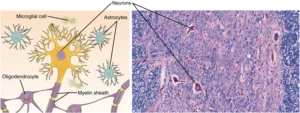
4. Main Components of Nervous Tissue
Nervous tissue consists of two main types of cells: neurons and neuroglial (supporting) cells.
A. Neurons
– Neurons are the functional units of the nervous system. They are specialized for transmitting electrical signals.
– Structure of a neuron:
– Cell body (soma): Contains the nucleus and cytoplasm; responsible for the metabolic activities of the cell.
– Dendrites: Short, branched extensions that receive signals from other neurons or sensory cells.
– Axon: A long projection that carries impulses away from the cell body to other neurons or effectors (muscles or glands).
– Axon terminals: End points where neurotransmitters are released to communicate with other cells.
Functions of neurons:
– Receive and transmit electrical impulses.
– Communicate between sensory organs, brain, spinal cord, and effectors.
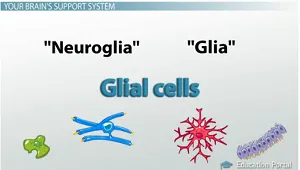
B. Neuroglial Cells (Glial Cells)
These are non-nervous cells that support, protect, and nourish neurons. They are more numerous than neurons and play vital roles in maintaining the health of the nervous system.
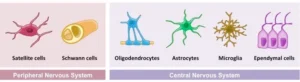
Types of neuroglial cells:
– Astrocytes: Support and maintain the chemical environment around neurons.
– Oligodendrocytes: Form myelin sheath in the central nervous system.
– Schwann cells: Form myelin sheath around peripheral nerves.
– Microglia: Act as phagocytes to remove debris and damaged cells.
– Ependymal cells: Line the ventricles of the brain and spinal canal, helping in cerebrospinal fluid circulation.
5. Types of Neurons Based on Function
– Sensory (afferent) neurons: Carry impulses from sensory receptors to the brain and spinal cord.
– Motor (efferent) neurons: Carry impulses from the brain and spinal cord to muscles or glands.
– Interneurons (association neurons): Connect sensory and motor neurons within the central nervous system.
6. Myelin Sheath and Nerve Impulse Transmission
Some neurons have an insulating layer called the myelin sheath that surrounds the axon.
Myelin increases the speed of impulse transmission.
Gaps between myelin segments are called Nodes of Ranvier, where impulses jump from node to node (saltatory conduction).
In the central nervous system, myelin is formed by oligodendrocytes, while in the peripheral nervous system, it is formed by Schwann cells.
7. Synapse
A synapse is the junction between two neurons or between a neuron and another cell (like a muscle cell). When an electrical impulse reaches the end of an axon, it triggers the release of chemical messengers called neurotransmitters, which cross the gap and transmit the signal to the next cell.
8. Clinical Relevance
– Nerve injury: May result in loss of sensation or paralysis depending on the location of damage.
– Multiple sclerosis: A disease where the myelin sheath is destroyed, slowing nerve conduction.
– Neuritis: Inflammation of nerves causing pain and weakness.
– Stroke: Occurs when blood supply to part of the brain is interrupted, leading to loss of function.
In complementary and alternative medicine, supporting nervous tissue involves proper nutrition (vitamin B complex, omega-3 fatty acids), herbal neurotonics, stress management, and meditation to enhance nerve health and function.
9. Summary
Nervous tissue is made up of neurons and neuroglial cells.
Neurons transmit electrical signals, while neuroglial cells provide protection and support.
The nervous tissue coordinates all body activities through sensory input, processing, and motor output.
Myelin sheath increases the speed of impulse transmission, and synapses enable communication between neurons.
Maintaining healthy nervous tissue is essential for proper brain function, coordination, and overall body balance, which is also a key focus in CAM practices.
Video Credits
The educational videos in this course are credited to the following creators:
All videos are embedded directly from YouTube for educational purposes and remain the property of their respective creators.