Specialized Connective Tissues I – Bone
1. Introduction
Bone is a specialized type of connective tissue that provides strong structural support and protection for the body. It forms the skeleton, which supports movement, protects internal organs, and serves as a reservoir for minerals such as calcium and phosphorus. Bone is a living, dynamic tissue capable of growth, repair, and remodeling throughout life.
2. Characteristics of Bone Tissue
Bone is hard because its matrix is impregnated with mineral salts, mainly calcium phosphate and calcium carbonate. Despite its hardness, it is not brittle because of collagen fibers that provide flexibility and strength. Bone is also highly vascular, meaning it has a rich blood supply for nourishment and repair.
3. Functions of Bone
Provides structural support for the body.
Protects vital organs such as the brain, heart, and lungs.
Serves as attachment points for muscles, enabling movement.
Stores essential minerals like calcium and phosphorus.
Houses bone marrow, which produces blood cells.
Participates in acid-base balance by releasing or absorbing minerals.
4. Composition of Bone
The composition of bone includes both organic and inorganic components:
Organic components (about 35%) – mainly collagen fibers and proteins that provide flexibility.
Inorganic components (about 65%) – mainly calcium and phosphate salts that give hardness and strength.
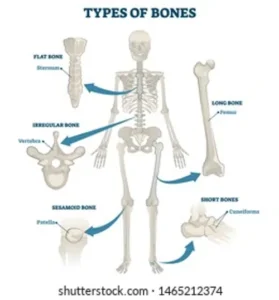
5. Types of Bone
A. Compact (Cortical) Bone
Dense and solid with few spaces.
Found in the outer layer of bones.
Composed of structural units called osteons or Haversian systems.
B. Spongy (Cancellous) Bone
Lighter and less dense than compact bone.
Contains spaces filled with red bone marrow for blood cell production.
Found mainly at the ends of long bones and inside flat bones.
6. Bone Cells
There are three main types of bone cells:
1. Osteoblasts – Bone-forming cells that produce the bone matrix. They are active during growth and repair.
2. Osteocytes – Mature bone cells that maintain bone tissue. They are found in small spaces called lacunae within the bone matrix.
3. Osteoclasts – Large, multinucleated cells responsible for bone resorption (breaking down old bone tissue).
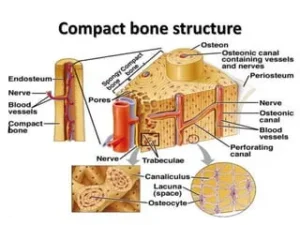
4. Microscopic Structure of Compact Bone
The compact bone is organized into repeating structural units known as Haversian systems (osteons). Each osteon consists of:
Haversian canal: Central canal containing blood vessels and nerves.
Lamellae: Concentric rings of calcified matrix surrounding the canal.
Lacunae: Small spaces between lamellae containing osteocytes.
Canaliculi: Tiny channels connecting lacunae, allowing nutrient and waste exchange.
8. Coverings of Bone
Periosteum: A tough outer covering of bone that contains blood vessels, nerves, and bone-forming cells. It plays a role in bone growth and repair.
Endosteum: A thin inner lining of bone cavities that also contains osteoblasts and osteoclasts.
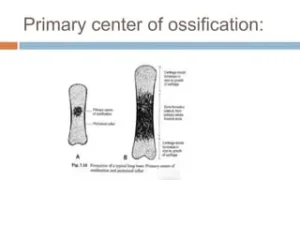
9. Bone Formation (Ossification)
Ossification is the process by which bone tissue is formed. There are two types:
Intramembranous ossification: Bone develops directly from connective tissue (e.g., flat bones of the skull).
Endochondral ossification: Bone develops by replacing cartilage (e.g., long bones like femur and humerus).
10. Blood and Nerve Supply
Bones are richly supplied with blood through the nutrient artery and periosteal vessels. Nerves accompany these blood vessels, providing pain sensation when bone is injured.
11. Clinical Relevance
Osteoporosis: A condition where bone becomes weak and brittle due to loss of minerals.
Fractures: Breaks in bone often resulting from trauma or disease.
Rickets and Osteomalacia: Caused by vitamin D deficiency leading to soft, poorly mineralized bones.
In Complementary and Alternative Medicine, maintaining strong bones involves adequate calcium intake, vitamin D, exercise, and the use of herbal supplements that support bone metabolism.
12. Summary
Bone is a living connective tissue composed of cells, fibers, and mineralized matrix.
It provides support, protection, and movement while serving as a storage site for minerals and a source of blood cells.
Its structural organization into compact and spongy bone allows strength with lightness.
Healthy bone maintenance is essential for overall body stability, and CAM approaches focus on nutrition, exercise, and herbal remedies to support bone health.
Video Credits
The educational videos in this course are credited to the following creators:
All videos are embedded directly from YouTube for educational purposes and remain the property of their respective creators.